Kwanzaa, Adoption, and the Work of Remaking What Matters

by April Dinwoodie
TRJ Executive Director

Growing up as a mixed-race Black child adopted into a white family, the holidays were full of excitement — the lights, the treats, the special once-a-year traditions.

But they were also exhausting.

Exhaustion from wondering about my family of origin.
Exhaustion from not seeing myself reflected anywhere around the table.
Exhaustion from hearing racially or culturally insensitive comments from extended family members.
Exhaustion from pretending everything felt the same for me as it did for everyone else.

What I needed wasn’t more gifts —
it was more understanding.
More curiosity.
More emotional support.
More space for all of who I was.

As I plan for the holidays this year and revisit the principles of Kwanzaa, I’m reminded that this celebration offers more than cultural practices — it offers a framework. A way of thinking. A grounding tool for families formed through adoption.

Created by Dr. Maulana Karenga, the seven principles of Kwanzaa — the Nguzo Saba — offer a meaningful structure for connection, reflection, and building family practices that honor identity and belonging.
Kwanzaa isn’t something to “add on.”
It’s something that can support us.
It helps families reflect, reconnect, and remake traditions with intention.

And the best part?
You do not have to do all seven principles perfectly.
You can return to them every year, adjusting as your child grows and your family evolves.

Every family is at a different point in their journey.
The work is simply to stretch as far as you truthfully can toward deeper belonging.

Here’s how each principle can gently guide you.

NGUZO SABA FOR ADOPTIVE FAMILIES
(The Seven Principles of Kwanzaa, created by Dr. Maulana Karenga)

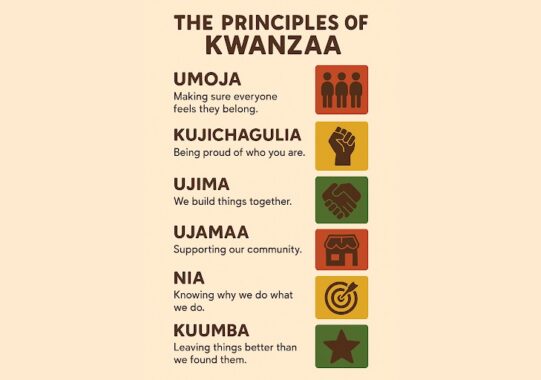
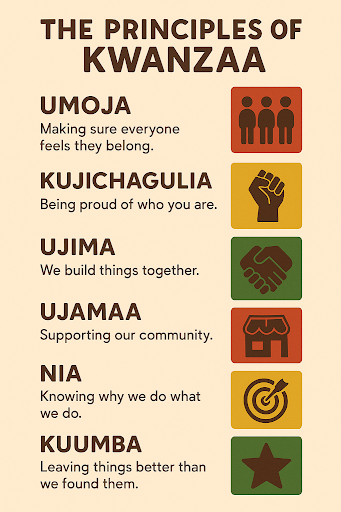
1. Umoja — Unity
Meaning: Making sure everyone feels they belong.
Adoption Lens: Unity grows when every child’s identity is honored.
Practice: Ask: “What helps you feel included during our holidays?”

2. Kujichagulia — Self-Determination
Meaning: Being proud of who you are.
Adoption Lens: Let children express and shape their identities openly.
Practice: Explore new holiday traditions and invite children to choose one that reflects their culture or interests.

3. Ujima — Collective Work & Responsibility
Meaning: We build things together.
Adoption Lens: Traditions don’t have to be inherited — they can be co-created.
Practice: Hold a quick “Holiday Check-In”:
What stays? What shifts? What’s something new we create?

4. Ujamaa — Cooperative Economics
Meaning: Supporting our community.
Adoption Lens: Community helps children feel culturally anchored.
Practice: Choose one local Black-owned, Indigenous-owned, or culturally relevant business to support together.

5. Nia — Purpose
Meaning: Knowing why we do what we do.
Adoption Lens: Traditions should support identity and connection, not pressure or performance.
Practice: Ask: “Why does this tradition matter? Whose story does it tell?” Adjust with intention.

6. Kuumba — Creativity
Meaning: Leaving things better than we found them.
Adoption Lens: Creativity helps families navigate complexity and build meaningful rituals.
Practice: Create or adapt one holiday ritual that honors your child’s culture, family of origin, or personal truth.

7. Imani — Faith
Meaning: Believing in ourselves and each other.
Adoption Lens: Children need adults who trust their truths and hold hope for their futures.
Practice: Offer this affirmation:
“All of who you are belongs here.”
As a child, I didn’t have language for what felt missing.
But I knew what belonged — and what didn’t.
This year, let Kwanzaa be an invitation. A tool. A path forward for families willing to stretch toward honesty, identity, and belonging.
Because when adoptive parents do even small things to honor the fullness of children.
when they create traditions with them instead of for them — the exhaustion can soften.

And that is the work of remaking what matters.

Practical Tips for Parents

(Choose one or two — a little truly goes a long way.)
✨ Start small. Pick one Nguzo Saba principle to explore this year.
✨ Be honest with yourself. Notice where traditions limit belonging.
✨ Invite your child in. Even one question opens connection.
✨ Adjust as you go. Holidays should evolve with your child’s needs.
✨ Revisit yearly. Belonging grows in layers, not all at once.
✨ Stay curious. Curiosity is more important than getting it “right.”

Most of all:
Stretch as far as you truthfully can — your effort builds a child’s bright path to belonging.

This post is from our December 2025 newsletter. If you would like to get our newsletter in your inbox each month, as well as information about our annual TRJ Family Camp and our monthly Zoom call providing support for our transracial adoption parents, please subscribe.


Book Corner – December 2025

Cemetery Songs

Julie Gilbert

Grades 8-12

Polly Stone lives with her white, adoptive parents in semi-rural Minnesota. When Polly’s biological mom dies from cancer, she runs across state lines to make it to her funeral or at least visit her grave. The police find Polly and return her back home. While mourning her loss, she decides to burn her adoption papers in a pile of kindling close to her school. The fire gets out of control and burns school property. Unable to focus on school, she takes time off. Polly plans to catch up over the summer and start her senior year in the fall, but struggles to get the work done. Polly’s only solace is her volunteer work at the local archive, where she is mentored by the town’s archivist, Tasha. Tasha is Black and supportive of Polly’s Black identity. They talk about HBCUs and have conversations like this: “People are always asking if they can touch my hair.” Tasha rolls her eyes. “Same. What else?” “Well, people stare a lot when I’m with my family, although that’s more of an adoption thing.” “It's a race thing, too.” “Yeah, and sometimes strangers ask dumb questions, like where I’m from. Or they’ll tell me how exotic I look or they say, ‘So, what are you?’” Polly and Tasha work on a research project together on property that’s about to be developed. They come to discover an old cemetery in Jessam Crossing. It may be a significant and historic site as it was part of a Black settlement. Polly knows a lot more than she and Tasha can discover from the archives, but how? Polly is able to communicate with a boy who is buried in the cemetery. With his help, they piece together the tragic tale of his demise, which is related to why his spirit cannot rest. Can they help each other heal and move on? In Gilbert’s “Recommended Reading” section she cites the work of Rhonda Roorda and Rita Simon including In Their Own Voices: Transracial Adoptees Tell Their Stories and In Their Parents’ Voices: Reflections on Raising Transracial Adoptees. "

https://www.abebooks.com/Cemetery-Songs-Gilbert-Julie-Lakestone-Press/30771310417/bd


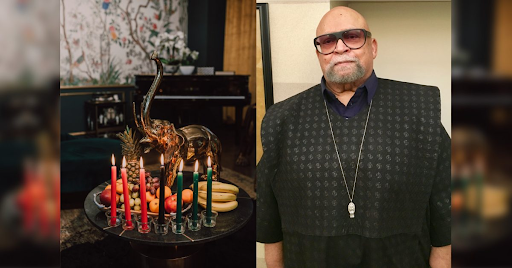
Black Excellence – Dr. Maulana Karenga

🕯️ Dr. Maulana Karenga: A Tradition of Self-Determination in the December Holidays

The end of the year invites reflection on our most cherished traditions. For the Black community, this reflection is often rooted in the dynamic legacy of Dr. Maulana Karenga, the scholar and activist who gifted the world with Kwanzaa in 1966. His creation is the ultimate example of an evolving tradition, offering a profound cultural framework for African Americans to celebrate themselves, their history, and their future during the December holiday season.

Kwanzaa, celebrated from December 26th to January 1st, was established in the aftermath of the 1965 Watts Rebellion in Los Angeles. Dr. Karenga conceived of the holiday not merely as an observance, but as an act of cultural recovery and reconstruction.

At its core, Kwanzaa was a conscious decision to evolve the holiday landscape. It was created to provide a non-religious, pan-African alternative and complement to existing December celebrations, allowing African Americans to root their end-of-year gatherings in collective values and African heritage.

"My goal was to 'give black people an opportunity to celebrate themselves and their history, rather than simply imitate the practice of the dominant society.'" - Dr. Maulana Karenga

The foundational structure of Kwanzaa is the Nguzo Saba (The Seven Principles), a set of communitarian values drawn from African philosophy. These principles perfectly embody the idea of expanding our thinking and actions, transforming abstract ideals into a seven-day commitment to community building:

Day 1 Umoja: Unity - Family, community, nation, and race.

Day 2 Kujichagulia: Self-Determination - To define, name, create, and speak for ourselves.

Day 3 Ujima: Collective Work & Responsibility - To build and maintain our community together.

Day 4 Ujamaa: Cooperative Economics - To build and profit from our own businesses together.

Day 5 Nia: Purpose - To restore our people to their traditional greatness.

Day 6 Kuumba: Creativity - To leave our community more beautiful and beneficial than we inherited it.

Day 7 Imani: Faith - To believe in our people and the righteousness of our struggle.

By dedicating each day to a principle, Kwanzaa actively fosters a tradition of reflection, self-affirmation, and collective action. It is a powerful cultural tool that helps families take a closer look at what traditions mean to us—shifting the focus from commercialism to ethical and communal values.

While originally conceived as an alternative to Christmas, Kwanzaa has matured into a celebrated and integrated part of the African American holiday experience. Many families choose to celebrate both holidays, weaving the cultural strength of the Nguzo Saba into their religious or secular Christmas observances.

Dr. Karenga's work has had a lasting impact by:

  • Providing Cultural Grounding: Offering a tangible way for people of African descent to connect with their ancestry and culture during the festive season.
  • Encouraging Self-Definition: Living up to the principle of Kujichagulia (Self-Determination) by having a holiday created by and for the Black community.
  • Fostering Unity: The emphasis on the Kikombe cha Umoja (Unity Cup) and the culminating feast (Karamu) on December 31st reinforces the essential communal spirit.

Dr. Maulana Karenga’s Kwanzaa remains a monumental example of Black excellence, demonstrating that the most enduring and meaningful traditions are often those we have the courage to create for ourselves.

Black Excellence Posts:

Each month, we take time to highlight the remarkable contributions of Black leaders, trailblazers, and changemakers whose impact continues to shape our world. These stories serve as a valuable opportunity for transracial families to learn, reflect, and engage in meaningful conversations about Black history and culture. We invite you to explore our past Black Excellence features in the carousel below, where you’ll find inspiring figures from various fields—activism, science, arts, sports, and beyond. If you haven’t already, be sure to subscribe to our monthly newsletter to receive these stories, along with discussion prompts and book recommendations, right in your inbox.


December – Reflections: Evolving Traditions 

The December holidays give us an opportunity to think about traditions tied to different cultures and religions. Regardless of what you and your family honor and celebrate, we can be inspired to take a closer look at what traditions mean to us and how we can expand our thinking and actions.

Read this month's reflection as well as previous December posts from over the years to help guide you and your family through the ideas of evolving traditions:

December Pro-Tip to Foster Conversations About Transracial Adoptions

At Transracial Journeys we send out cues for conversations each month. Our Transracial Journeys card deck contains 3 cards for each month that the children use to ask their parents questions. Below are the questions for December. Before getting started, read the parent pro-tip each month.

December Pro-Tip for Parents: Resist the urge to hold tight onto traditions that may be holding you back from fully embracing new ideas that may better honor your child’s culture. Also think about simplifying or modifying some of the traditions you now honor to make room for new ones.

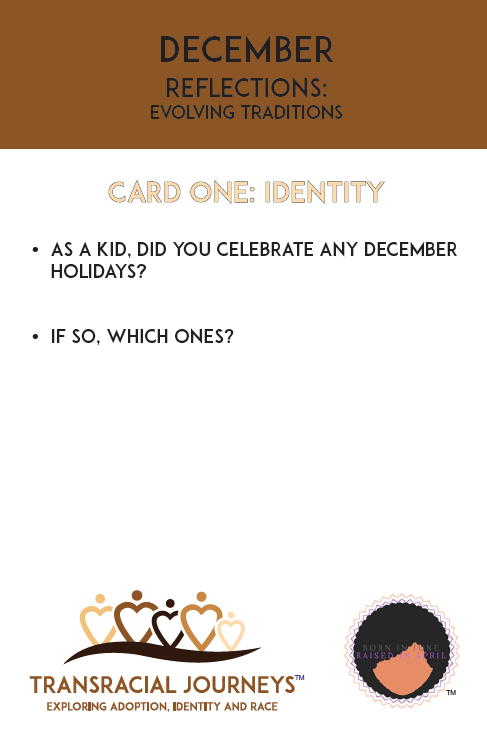
CARD ONE: IDENTITY
• As a kid, did you celebrate any December holidays?
• If so, which ones?

CARD TWO: RELATIONSHIPS
• Were there things that you would do year after year as a family during the month of December or maybe other months of the year?

CARD THREE: EMBRACING AND FACING DIFFERENCES OF RACE AND CULTURE
• What are some new traditions or holidays you’d like to learn more about and/or try?

This post is from our December, 2025, e-newsletter. If you would like to get our newsletter in your inbox each month, please subscribe.


Setting the Holiday Table in Complex Times: Nourishing Family Narratives

by April Dinwoodie
TRJ Executive Director

When I was growing up, my mom would always say a beautiful and simple Thanksgiving prayer. Every year, we’d close our eyes, hold hands, and listen to her voice rise and fall. The smell of turkey filled the air, and for a few moments everything felt still. I remember feeling thankful—surrounded by love, warmth, and the familiarity of family.

But I also remember the ache—the quiet wondering. My family of origin was never mentioned among the members of the extended family who were missing and prayed for. I thought of them every year. Were they celebrating too? Did they wonder about me the way I wondered about them?

Now, looking back, I realize that we were closing our eyes in more ways than one. We were closing our eyes to the family that wasn’t there, and to the history of the day itself—the story of this country, the Indigenous lives and legacies that were disrupted, the realities of what was taken and what was lost.

That unspoken tension—the both/and of Thanksgiving—has always lived inside me. The deep thankfulness for what I have, held right alongside the awareness of what’s missing and what must be named.

November and the Table of Truth

As we move into November, which is also National Adoption Awareness Month, the family table takes on even deeper meaning. It becomes a mirror—a place where stories of legacy, history, and belonging meet. For adoptive and especially transracial adoptive families, the holiday table can hold layers of love, difference, and longing all at once.

At Together on the Journey, we know that the table is more than a piece of furniture. It’s a symbol of connection and story. Who gathers around it—and who is missing—tells us a lot about how we understand family.
In my childhood home, we didn’t have words for that complexity, but I felt it deeply. The silence around my family of origin matched the silence around the history of Thanksgiving. Both were wrapped in good intentions, but both left important truths unspoken and left me to navigate the difficulties silently.

This year, instead of closing our eyes, let’s open them together. We can be thankful for the people around us and honest about the people and histories that are missing. We can hold thankfulness and truth at the same table.

Try this:
When it’s time to share what you’re thankful for, add a second invitation:

  • “What has been hard this year?”

This simple act can open space for honesty, empathy, and connection—reminding everyone that joy and difficulty can live side by side.

Expanding the Story of the Day

For some, Thanksgiving is a treasured family ritual. For others, it’s a reminder of pain and loss. Both truths can coexist. We can be thankful for the love we share while also being mindful of the full story of this day.

Consider how your family names and frames the holiday. Maybe you call it A Day of Thanks and Truth, Harvest Gathering, or simply Family Day. Learn about the Indigenous peoples whose land you live on. Talk about what was taken, not just what was shared. These small shifts don’t erase tradition—they expand it. They help children entrusted to you see that thankfulness and awareness can live together.

Telling the Truth Beautifully

For adopted people, the holidays often carry that same blend of joy and longing. Parents may want to make the day perfect, but what children often need most is honesty, not performance. Sometimes the most loving thing we can do is say out loud what everyone already feels.

Maybe that means lighting a candle for a family of origin. Maybe it’s saying, “We’re thankful for those who can’t be here,” and letting that sentence mean many things. It might even mean sitting in quiet reflection, acknowledging both the family gathered and the family unseen.

Making Space for the Whole Story

Every family has its own rhythm, its own version of the both/and. For some, it’s thankfulness and missing pieces. For others, it’s pride and pain, belonging and uncertainty. The goal isn’t to fix or smooth those feelings—it’s to let them breathe.
When we make room for all of it, we teach our children that they don’t have to choose between being thankful and being honest. They can be both.

Try this:
If something hard comes up during the holiday, take a breath before responding. You don’t need the perfect words.

  • A simple “I hear you” or “That makes sense” can be enough to open connection and build trust.

A Table of Thankfulness and Truth

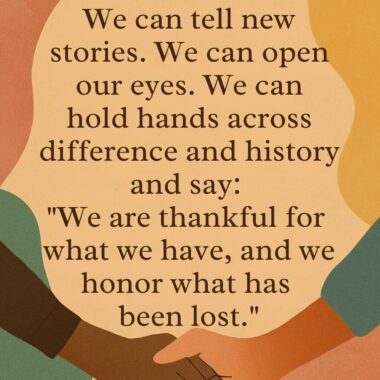
When I think back to those moments of my childhood—the prayer, the warmth, the silence—I wish we had found words to hold the fullness of our experience. But now I know that each of us can begin again. We can tell new stories. We can open our eyes. We can hold hands across difference and history and say:

  • “We are thankful for what we have, and we honor what has been lost.”

That’s the table I want us all to set together now—a table where love and truth sit side by side, and where everyone, past and present, has a place.

Reflection Prompts for Families

  • What truths about Thanksgiving and adoption have been left unspoken in our home?
  • Who is at our table—and who is missing?
  • How can we honor both thankfulness and truth in the way we gather?
  • What new names, rituals, or stories might reflect our family’s values more fully?

This post is from our November 2025 newsletter. If you would like to get our newsletter in your inbox each month, as well as information about our annual TRJ Family Camp and our monthly Zoom call providing support for our transracial adoption parents, please subscribe.

November Nourishment: Sustaining Strong and Healthy Families

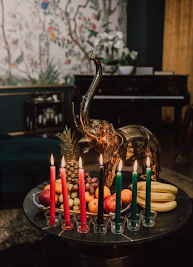
Thanksgiving can be one of the more complicated historical holidays, and for many in the United States, one of the more family and food-centric holidays. Whether you are a family that chooses not to mark Thanksgiving in a traditional way, or your family goes all out with a big Thanksgiving celebration, this month we are thinking about the family table and what might be true when there are differences of race and culture with transracial adoption. November also brings National Adoption Awareness Month, (NAAM) which can be challenging for some adopted persons. This month prompts on your activity deck include questions for both areas of discussion.

November Tip to Foster Conversations About Transracial Adoption

At Transracial Journeys we send out cues for conversations each month. Our Transracial Journeys card deck contains 3 cards for each month that the children use to ask their parents questions. Below are the questions for November. Before getting started, read the parent pro-tip each month.

November Tip for Parents: Talking about family and complicated history can activate deep-seated emotions and feelings. Make sure you have the support you need to process your feelings before and after the conversations you may have with your children.

Reference this month's feature article, Setting the Holiday Table in Complex Times: Nourishing Family Narratives, for more insight from a transracial adoptee's perspective. 

November Transracial Journeys Cards

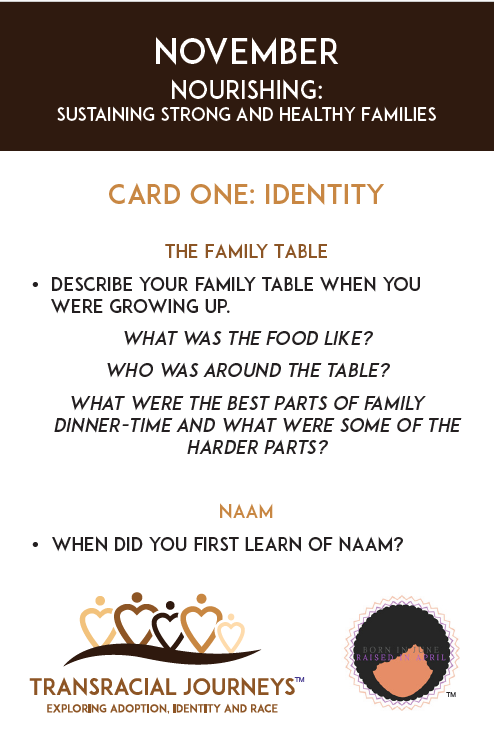
CARD ONE: IDENTITY
The Family Table: Describe your family table when you were growing up.  What was the food like?  Who was around the table? What were the best parts of family dinner-time? What were some of the harder parts?
NAAM: When did you first learn of NAAM?

CARD TWO: RELATIONSHIPS
The Family Table: Who were the people sitting around your family table?
NAAM: What does NAAM mean to you?

CARD THREE: EMBRACING AND FACING DIFFERENCES OF RACE AND CULTURE
The Family Table: Were there ever people of different races around your family table?
NAAM: How can we find our own unique ways to honor and mark NAAM?

This post is from our November, 2025, newsletter. If you would like to get our newsletter in your inbox each month, please subscribe.


Book Corner – November 25

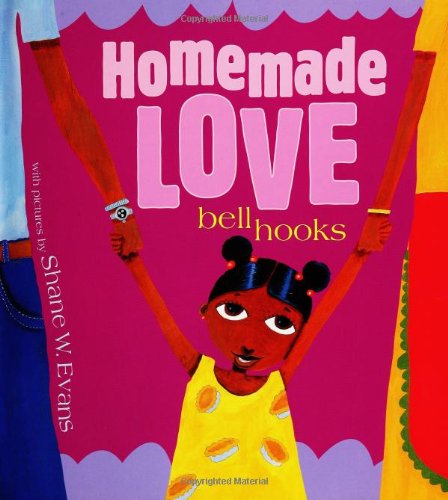
Homemade Love

bell hooks

Illustrated by Shane W. Evans

Baby and Up

Mama calls her Girlpie, and she’s Daddy’s honey bun chocolate dew drop. But when she does something naughty, will Mama and Daddy still love her? YES! This colorful board book is a sweet celebration of family love.

https://www.abebooks.com/servlet/BookDetailsPL?bi=30873322398&dest=usa


Black Excellence – Dr. Tiya Miles

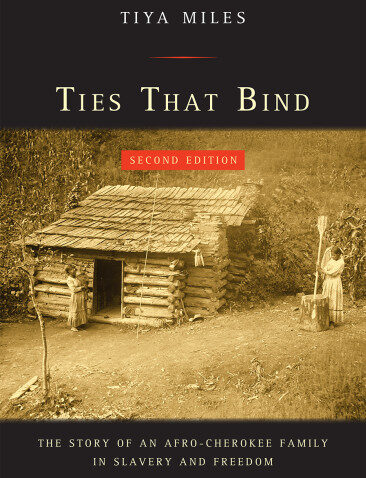
Dr. Tiya Miles: Weaving Truth and History

As we gather around our holiday tables this November -National Adoption Awareness Month -we’re reminded of how stories shape our understanding of family, history, and home. This month’s Black Excellence spotlight honors Dr. Tiya Miles, a historian and storyteller whose work helps us see the fullness of those connections.

Dr. Miles is the author of Ties That Bind: The Story of an Afro-Cherokee Family in Slavery and Freedom, a groundbreaking book that explores the intertwined lives of African and Cherokee people in early America. Through this and subsequent works -including The House on Diamond Hill: A Cherokee Plantation Story, The Dawn of Detroit: A Chronicle of Slavery and Freedom in the City of the Straits, and her National Book Award -winning All That She Carried: The Journey of Ashley’s Sack, a Black Family Keepsake -Miles invites us to look beyond simplified narratives and into the layered, lived realities of identity, land, and lineage.

Her writing sits at the crossroads of African American, Native American, and women’s histories - places where truth is often complex and sometimes painful, but always necessary. Like the work of families navigating transracial adoption, Miles’s research calls us to open our eyes to what’s been missing and to honor the beauty that emerges when we do.

In a month that asks us to reflect on both thankfulness and truth, Dr. Tiya Miles reminds us that telling the whole story -of our families, our nation, and ourselves -is an act of love. Her scholarship is a model of what it means to hold history tenderly and to make space at the table for every part of who we are.

Learn more about Dr. Miles’s work at www.tiyamiles.com.

Black Excellence Posts:

Each month, we take time to highlight the remarkable contributions of Black leaders, trailblazers, and changemakers whose impact continues to shape our world. These stories serve as a valuable opportunity for transracial families to learn, reflect, and engage in meaningful conversations about Black history and culture. We invite you to explore our past Black Excellence features in the carousel below, where you’ll find inspiring figures from various fields—activism, science, arts, sports, and beyond. If you haven’t already, be sure to subscribe to our monthly newsletter to receive these stories, along with discussion prompts and book recommendations, right in your inbox.


Behind the Mask: The truth about belonging, identity, and the narratives we navigate

by April Dinwoodie

When Hiding Becomes Habit

Throughout my life, I’ve become aware of how naturally I can mask — how easily I learned to protect parts of myself that felt confusing, painful, or “too much.”

As an adopted person, curiosity has always lived right next to fear: curiosity about who I am and where I come from, and fear about what might happen if I asked too many questions or revealed my true emotions of grief and loss.

Connections over the years with what I call the extended family of adoption and foster care — adopted persons, families of origin, adoptive families, folks who experienced foster care, and professionals — have shown me that the stories we’re given about adoption shape what we feel safe to express.

Masking, in that sense, isn’t about pretending; it’s about surviving. It’s about finding ways to belong in a world that may not yet be ready for our full truth.

More Than a Costume

Halloween is a time when masks and costumes take center stage — when it’s acceptable, even celebrated, to play with identity and transformation. But for me, and for many others connected to adoption, masking can be something we’ve practiced far beyond a single night.

We mask our longing for information.
We mask our fear of rejection.
We mask our curiosity about where we come from.
And sometimes, we even mask our pride in who we’ve become.

This month, as many play with costume and disguise, I’m looking more closely at what’s underneath — to honor the complexity, the curiosity, and the courage it takes to live unmasked as an adopted person.

When Curiosity Meets Culture

This season always brings up tension around cultural appropriation and appreciation — about who gets to try on an identity for fun, and who must hide theirs to feel safe. That dynamic feels especially sharp right now, in a climate where race, belonging, and representation are being debated and distorted in real time.

For families formed through transracial and intercountry adoption, October can be a month of reckoning. Costumes that make light of race, ethnicity, or immigration status — whether Blackface, ICE agents, or other caricatures — are not harmless. They are reminders that some people’s lived realities are still seen as entertainment, while others’ humanity is still questioned.

For adoptive parents raising Black and Brown children, this is a time to stay close, pay attention, and prepare. Children notice. They see what is celebrated and what is mocked. They feel when something is off, even if they don’t yet have the words for it.

These moments are opportunities for conversation — about safety, identity, respect, and the difference between imitation and understanding.

For me, unmasking is about giving myself permission to stay curious — even when it’s uncomfortable — and to listen deeply to the stories beneath the surface, in myself and in others. That same curiosity, when modeled by parents, can create the kind of family culture where children feel seen, protected, and proud of who they are — without having to hide behind any mask.

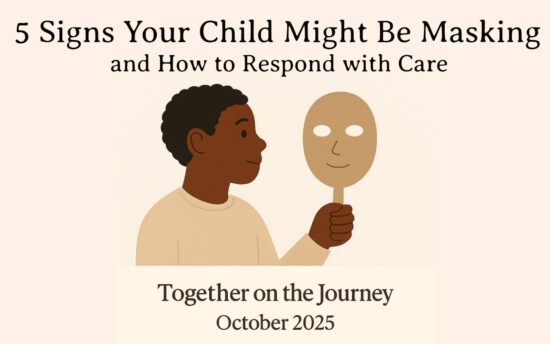
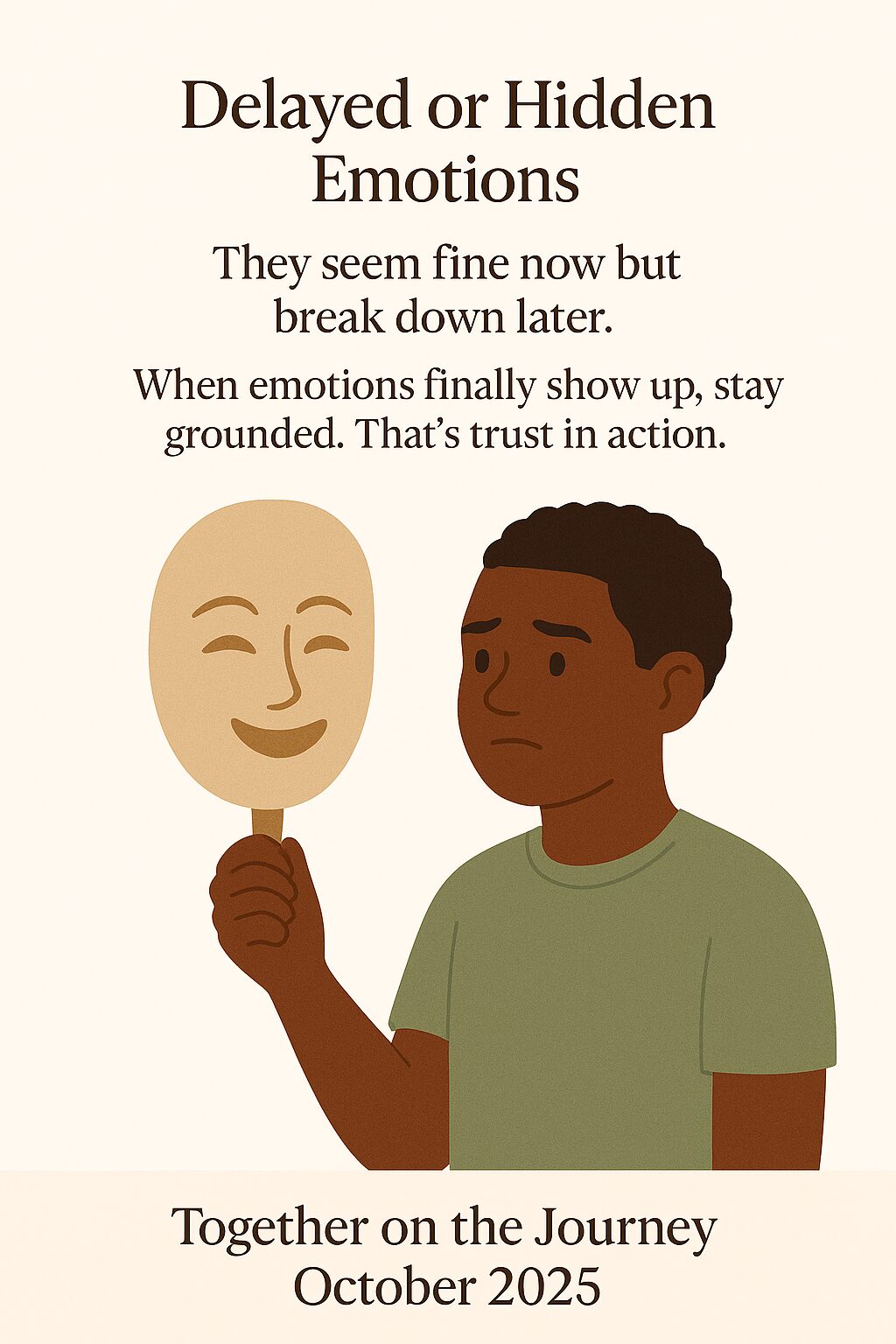
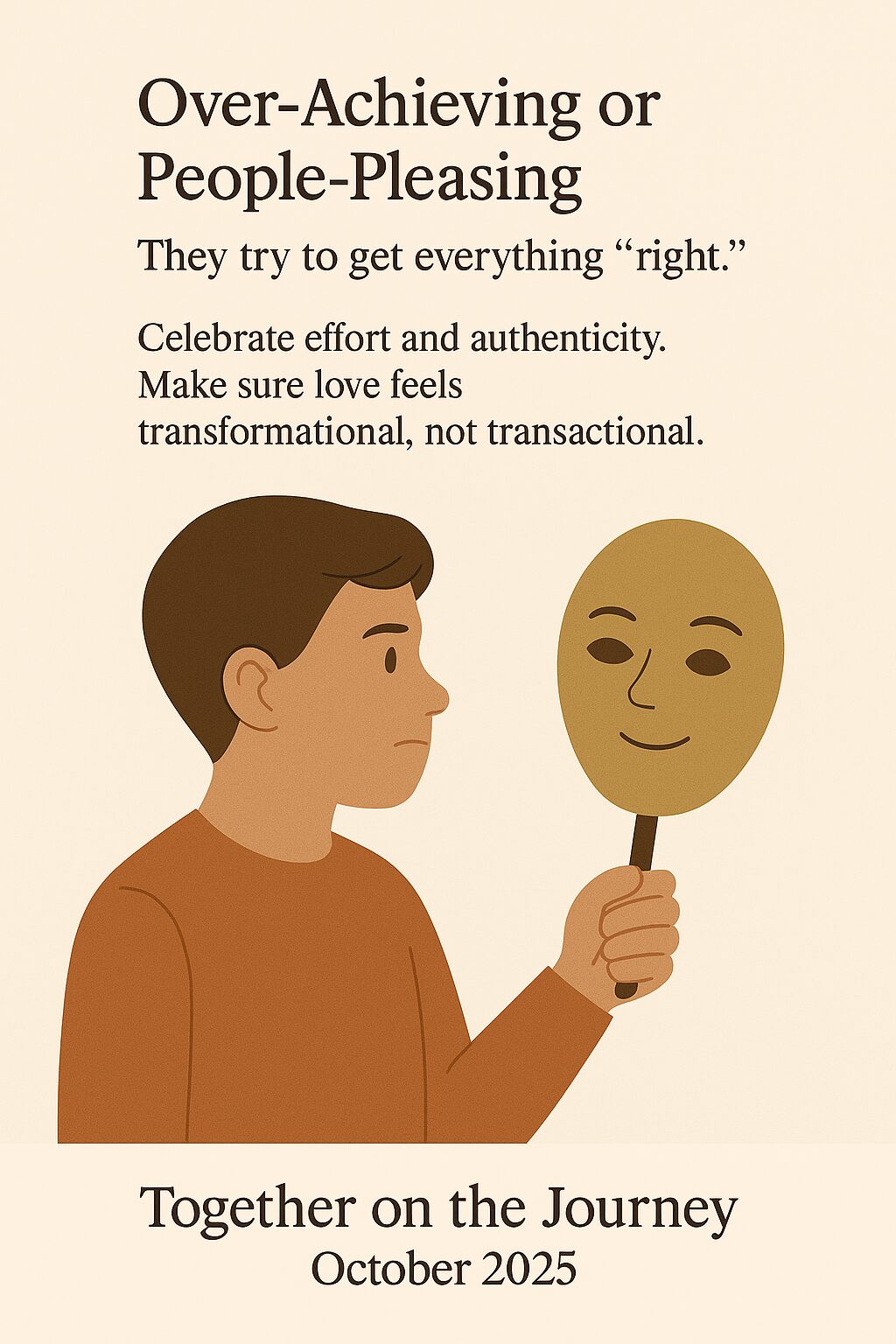
5 Signs Your Child Might Be Masking - and How to Respond with Care

Scroll through the image carousel on this page for more ideas on how to identify that your child is masking and techniques for responding with care. 

  1. Delayed or Hidden Emotions
  2. Performing Gratitude or Perfection 
  3. They Say "I'm Fine" When They Are Not
  4. Over-Achieving or People-Pleasing
  5. Avoiding Adoption or Hard Feelings

Reflections for Families

  • What helps me and my child feel safe enough to unmask?
  • How do we make space for each other to explore and show up as our whole selves?
  • What stories have we inherited — and which ones are we ready to rewrite together?
  • How can we model curiosity, empathy, and awareness during this season of masks and make-believe?

Looking Ahead to November

As we move toward National Adoption Awareness Month, let’s reflect on how we can shift from being talked about to being heard from. “Behind the Mask” reminds us that belonging begins with truth — and that every time we unmask, we make it a little easier for someone else to do the same. Listen to the October episode of Calendar Conversations for more.  https://podcasts.apple.com/us/podcast/calendar-conversations-a-guide-for-adoptive-parents/id1728489802?i=1000731211477

This post is from our October 2025 newsletter. If you would like to get our newsletter in your inbox each month, as well as information about our annual TRJ Family Camp and our monthly Zoom call providing support for our transracial adoption parents, please subscribe.

Book Corner – October 25

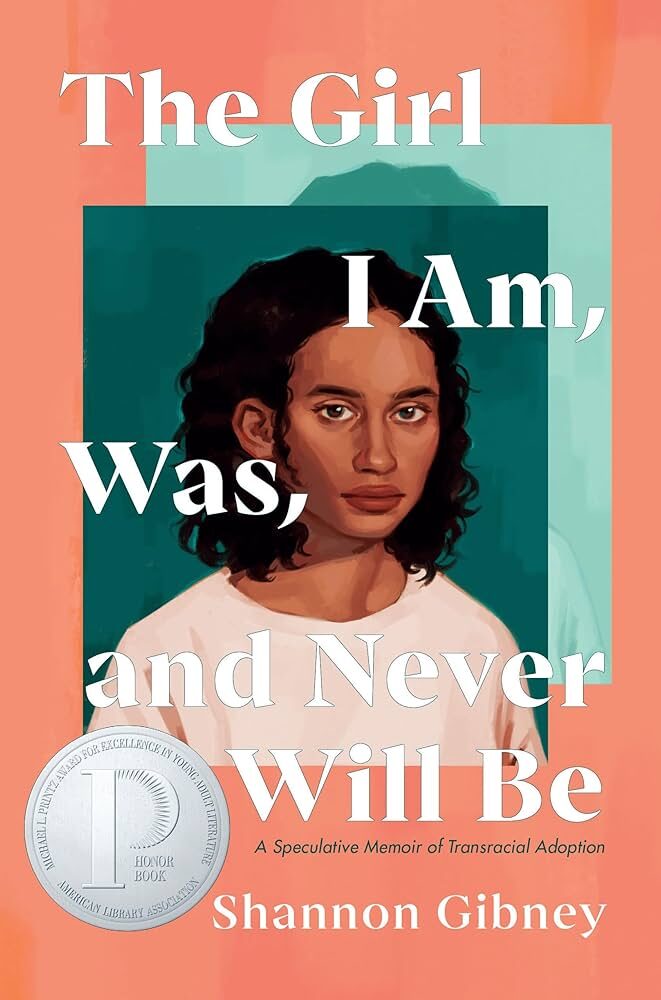
The Girl I Am, Was, and Never Will Be:

A Speculative Memoir of Transracial Adoption

by Shannon Gibney
Ages 14-17

Gibney features herself as the protagonist in this part memoir, part speculative fiction novel. Shannon Gibney and Erin Powers are one and the same person. However, there’s a primal difference in that one was adopted and the other wasn’t.

Using documents like vital records, correspondence written from her birth mother to her adoptive mother, and photographs of herself and family members, Gibney delivers a layered, complicated and enthralling tale told in the often underheard voice of a transracial adoptee. The author using her own name and photographs in the book make this book read like part autobiography and part science fiction.

The book is a challenging read that requires some suspension of disbelief. However, in the often misunderstood or misrepresented narrative of adoption, this story is an “authentic” piece of fiction written by a transracial adoptee. Shannon/Erin gets to be an explorer who time travels and jumps to other dimensions in order to piece together the story of not only the families that made and raised her but of the family she builds for herself well into her adulthood.

This book comes highly recommended for families formed by transracial adoption. The style and subject matter don’t make for an easy read but what valuable books are (easy reads)?

Don’t just hand this off to a teen to read in a vacuum, read it with them. If they want to talk about it, then discuss. If they don’t want to talk it’s still important for non-adoptees to read books like this and show they care about the perspective, identity and narrative of the transracially adopted person. Just as Shannon and Erin catch glimpses of each other or their birth father at different points in space and time, the reader may catch glimpses of what it’s like to walk in the shoes of a transracial adoptee.

Highly recommended!

https://www.abebooks.com/servlet/BookDetailsPL?bi=32105044908&dest=usa